
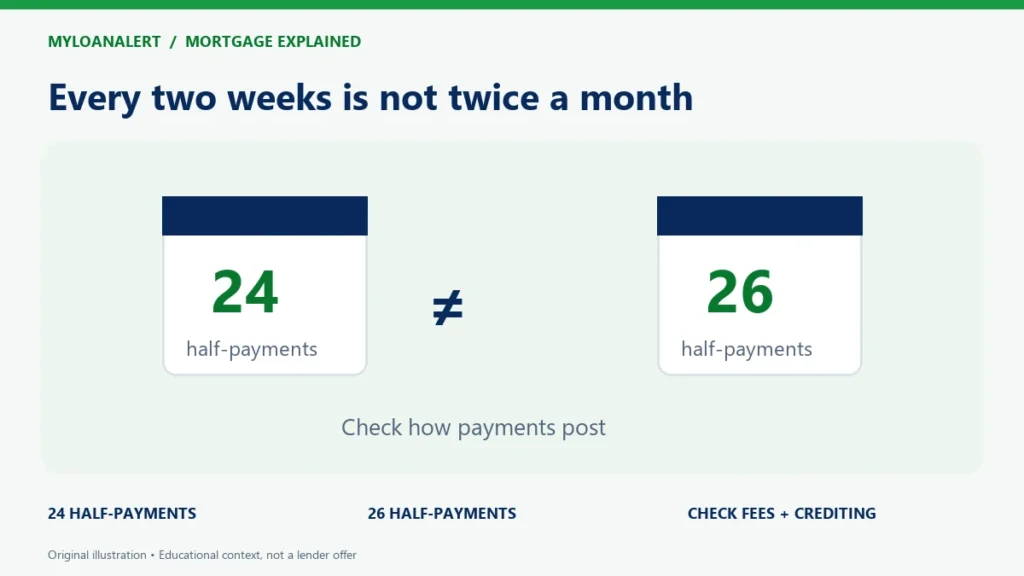
The short answerA typical biweekly plan makes 26 half-payments a year, equal to 13 full monthly payments. The extra annual amount can speed repayment. Fees and the way payments are credited can change the benefit, so compare the plan with simply adding extra principal yourself.
Pay half the mortgage every two weeks and finish sooner: that is the pitch. There is useful math behind it, but the calendar is doing part of the work. Before paying to join a program, find out what happens to your money between the day it leaves your account and the day it reaches the loan balance.
Count the payments correctly
Two half-payments each month produce 24 half-payments a year. Every two weeks usually produces 26. That is why biweekly and twice-monthly payments are not interchangeable terms.
In a standard half-payment plan, those 26 installments amount to one more full monthly payment than the usual 12. It is additional money paid by you, not a special reduction in your loan rate.
Ask when the servicer credits the money
Find out whether each partial payment immediately reduces principal or is held until a complete payment is available. Ask when the extra annual amount is credited and how weekends or posting delays are handled.
Keep making the required payment on time. Do not change your payment schedule without confirming that the servicer will accept it and that it satisfies the loan’s due-date requirements.
Compare the fee-free alternative
Ask about setup and transaction fees. Then compare the program with a regular monthly payment plus extra principal.
If your regular principal-and-interest payment is $1,800, one extra payment a year is $1,800. Spreading that amount across 12 months means $150 extra each month. The crediting dates may differ, so equal yearly totals need not produce exactly equal results.
Choose the schedule you can maintain
A schedule aligned with your paycheck may be convenient. Convenience is a real benefit, but put a price on it before agreeing to a fee. Check whether your own servicer offers an acceptable direct arrangement.
The extra-payment calculator lets you test other plans too. A monthly extra or occasional lump sum may suit your budget better than a fixed biweekly commitment.
A simple example
At $1,800 a month, 12 full payments total $21,600. Twenty-six payments of $900 total $23,400: $1,800 more. Subtract any program fees and check posting dates before calling that difference a saving. The saving is the estimated interest avoided, not the extra money you contribute.
Illustrative assumptions, not current lender pricing or promised savings.
Questions people ask
Do I need to pay a company to make biweekly payments?
Ask your servicer what it supports directly. You may also be able to make designated extra principal with normal monthly payments.
Will a calculator know my servicer’s posting rules?
No. Enter the applicable fees and use the crediting scenarios as illustrations. Confirm the actual program terms.
Try this with your numbers
Use your lender’s quote and your own assumptions. No signup is needed for the calculator.
Compare my payment schedules →
See the free account · Compare more with Plus — $30 USD/year
New signup is coming soon. Existing accounts can save an offer or goal. Paid checkout is coming soon. Automatic monitoring and email alerts are not active yet.
Sources and further reading
Educational information and estimates only. Confirm loan terms and eligibility with your lender or servicer. MyLoanAlert does not originate or approve loans. Read our disclosures.