
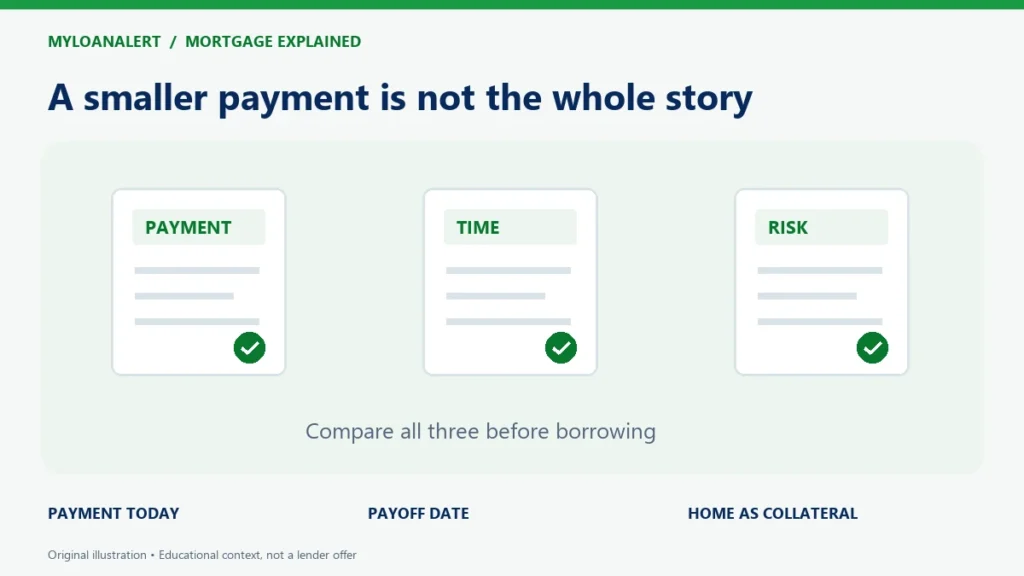
The short answerDebt consolidation can simplify payments, but a lower monthly bill does not prove a lower total cost. Compare fees, interest, repayment time and debt remaining. Using home equity to repay unsecured debts also puts the home behind those new loan obligations.
Combining three bills into one can feel like progress. Sometimes it is. But a payment can shrink because a rate falls, because repayment stretches out, or because both happen together. Before replacing your debts, find out which change is doing the work—and whether you are comfortable with the risk.
Write down the debts you would replace
For each balance, record the rate, current payment and realistic payoff plan. Use an actual repayment plan for revolving debt rather than assuming minimum payments will end on a predictable date.
Decide whether you would close accounts or leave them available. The calculator cannot prevent a paid-off card from building a new balance later.
Compare the complete new loan
Include origination charges and financed fees. For a cash-out refinance, bring the entire first mortgage into the comparison. For a fixed home-equity loan, keep the first mortgage and add the second loan’s payment and costs.
Use the same cash needed to clear the chosen debts. Borrowing an additional amount for spending creates a different comparison.
Look beyond this month’s payment
Check total borrowing costs and the payoff date. Then see what remains owed at the same end date under both paths. A long repayment period can turn a manageable-looking payment into years of additional interest.
Try applying some of the monthly payment reduction as extra principal. Treat that as a separate plan, not an automatic benefit you are guaranteed to follow.
Keep the home risk in the decision
A home-secured loan can create foreclosure risk if you cannot meet its obligations. That is a different consequence from leaving debt unsecured. A calculator’s cost result does not decide whether taking that risk is suitable for you.
If the debt problem came from a budget shortfall, work on that shortfall too. Consider discussing alternatives with a reputable nonprofit credit counselor before using home equity. A new loan changes the debt’s structure; it does not erase it.
A simple example
A $400 payment for five years and a $200 payment for fifteen years are not equivalent commitments. With level payments, they total $24,000 and $36,000 respectively before any fees or other changes. Actual consolidation terms need a full comparison, but the simple example shows why the payoff date matters.
Illustrative assumptions, not current lender pricing or promised savings.
Questions people ask
Does debt consolidation pay off my debt?
It usually replaces selected debts with a new obligation. You still owe the new loan, plus its applicable costs.
Can I compare a HELOC here?
This calculator models specified installment-loan scenarios. A HELOC’s changing rate, draw period and repayment terms require a different model.
Try this with your numbers
Use your lender’s quote and your own assumptions. No signup is needed for the calculator.
Compare my debt repayment paths →
See the free account · Compare more with Plus — $30 USD/year
New signup is coming soon. Existing accounts can save an offer or goal. Paid checkout is coming soon. Automatic monitoring and email alerts are not active yet.
Sources and further reading
Educational information and estimates only. Confirm loan terms and eligibility with your lender or servicer. MyLoanAlert does not originate or approve loans. Read our disclosures.