
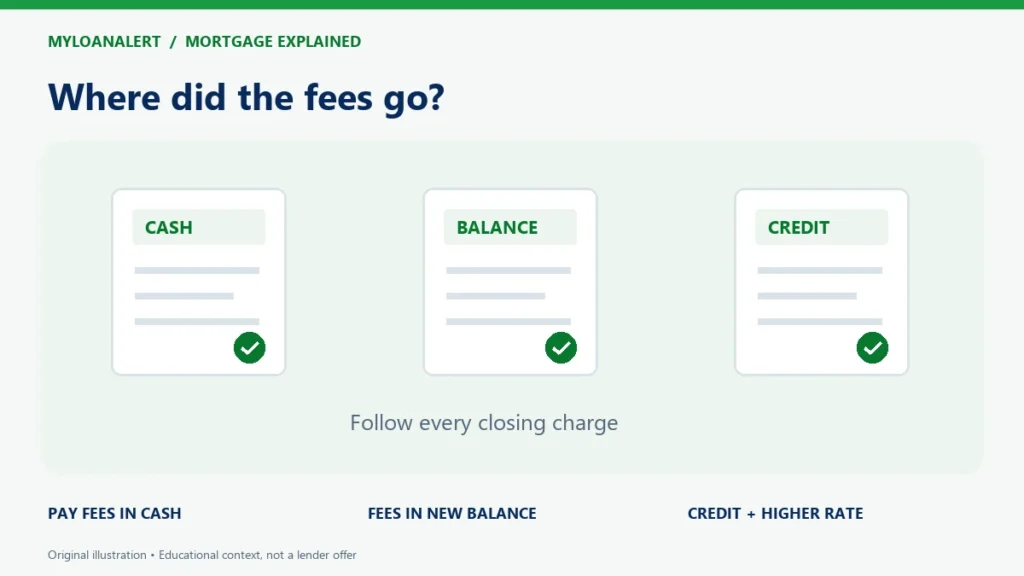
The short answerA refinance described as having no closing costs may offset fees with lender credits or finance costs into the new loan. Ask where each charge goes, then compare the payment and total borrowing cost with an option that pays fees upfront.
“Nothing out of pocket” can be reassuring when you are trying to lower a monthly bill. But cash due today is only one part of the deal. Before signing, ask a plain question: If I am not paying these costs now, how am I paying them? The answer belongs in your refinance comparison.
Look for a higher balance or a higher rate
If charges are added to your loan, you borrow more. If a lender credit covers them in exchange for a higher rate, the cost may show up in future interest. Both arrangements can change the result compared with paying the same fees in cash.
Read the written breakdown. The label alone does not tell you which arrangement you have, or whether prepaid items and escrow deposits still require cash.
Compare the same refinance in two versions
Ask for a cash-paid version and a version using credits or financed fees. Keep the loan purpose and term consistent where possible. Record the new amount borrowed, the interest rate, net fees and cash needed under each option.
Then compare each new loan with your current mortgage. Use the balance and time remaining today, not the amount you originally borrowed years ago.
Watch the payoff date
Restarting a long term can lower the payment even when it does not lower the total cost. Look at the months added, interest over your expected holding period and debt remaining at that date.
Read what happens when you restart a 30-year mortgage if the new payment seems dramatically smaller. Part of the reduction may come from taking longer to repay.
Choose a target you can explain
Instead of “I want a lower rate,” try “I want a smaller payment without adding too much debt” or “I want to recover the fees before I expect to move.” That makes the calculation more useful.
Existing MyLoanAlert accounts can save a target to revisit. Automatic rate monitoring and email alerts are coming soon. A national rate benchmark is context; a fresh lender quote is what you use to rerun the numbers.
A simple example
A homeowner owes $240,000. Adding $4,000 of fees creates a $244,000 loan before other adjustments. The $4,000 has not vanished. Compare that balance with a $240,000 loan where fees are paid in cash, using each lender’s actual rate and the same end date.
Illustrative assumptions, not current lender pricing or promised savings.
Questions people ask
Can a no-closing-cost refinance be useful?
It may fit someone who values lower upfront cash needs. Whether it reduces costs depends on the rate, fees, term and time the loan is kept.
Can I use the national average rate in this calculation?
Use your own lender quote for the new loan. A national average is not a rate offered to you.
Try this with your numbers
Use your lender’s quote and your own assumptions. No signup is needed for the calculator.
See the free account · Compare more with Plus — $30 USD/year
New signup is coming soon. Existing accounts can save an offer or goal. Paid checkout is coming soon. Automatic monitoring and email alerts are not active yet.
Sources and further reading
Educational information and estimates only. Confirm loan terms and eligibility with your lender or servicer. MyLoanAlert does not originate or approve loans. Read our disclosures.